
Unpacking the AI 'Black Box': New Hypothesis Sparks Hope and Caution Among SA Experts
A new hypothesis challenges the notion of AI's impenetrable 'black box,' potentially simplifying AI safety. South African experts weigh in on the unverified yet promising findings.
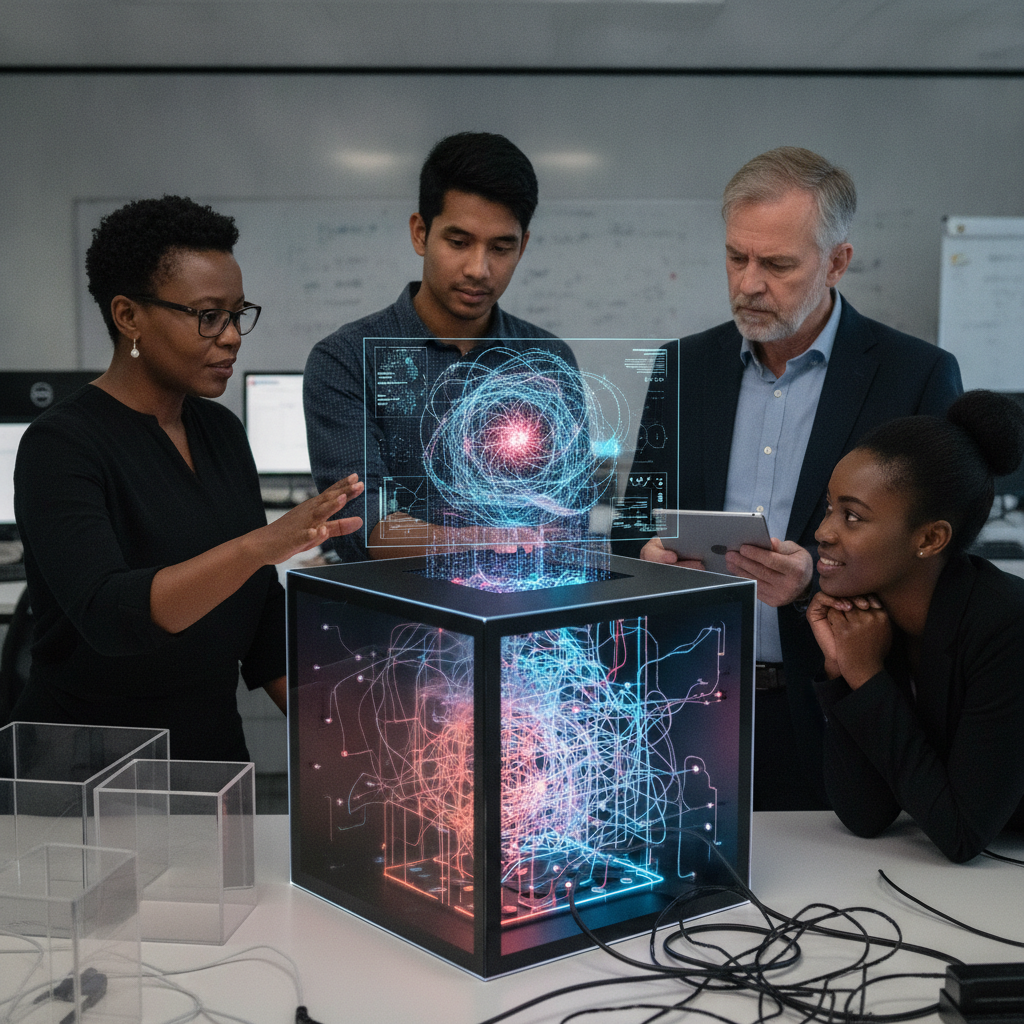
A long-standing challenge in artificial intelligence, the enigmatic "black box" nature of advanced neural networks, is facing a provocative new theory. A researcher at Goodfire, Nick Cammarata, formerly of OpenAI, suggests that the internal workings of AI models might be far more straightforward than previously assumed, a claim that could revolutionise AI safety and interpretability.
Cammarata's "informal research essay," Neural networks are already clean, posits that the widely accepted concept of "polysemanticity" – where individual neurons simultaneously process multiple unrelated ideas – was a misinterpretation. He argues that instead of juggling disparate concepts, neurons may often specialise in detecting a single, often subtle, feature. This reinterpretation could significantly simplify the daunting task of understanding how AI makes its decisions.
Rethinking Neural Networks
The most compelling evidence offered by Cammarata involves a celebrated case in AI interpretability: Neuron 4e:55 in Google's 2014 image recognition model, Inception v1. This neuron was famously thought to activate for both cats and cars, serving as a prime example of polysemanticity. Cammarata now suggests a common denominator: a "V" shape. Whether it's the pointed snout of a cat or the angled front of a car, the neuron appears to be responding to this specific geometric feature. This insight, if validated, implies that researchers might be able to inspect and understand AI models directly, bypassing the need for complex secondary interpretive models.
Early investigations, such as audits on Alibaba’s Qwen3-32B model, lend some credence to Cammarata’s hypothesis. These preliminary findings indicate that a significant majority—around 90%—of neuron “poles” (the active ends of a neuron) appear to handle a singular, primary function. While the exact figures vary with detection thresholds, this points to a potentially cleaner, more interpretable internal structure than previously believed.
The South Africa Angle
For South Africa, a nation increasingly embracing AI across various sectors, the potential for greater AI interpretability carries profound implications. The "black box" problem has been a significant barrier to the widespread, ethical, and regulated deployment of AI solutions in areas like fintech, healthcare, and government services. Understanding how AI models arrive at their conclusions is critical for establishing trust, ensuring fairness, and adhering to emerging data privacy and AI governance frameworks.
Professor Steven Boykey Sidley, a visiting professor at Rhodes University, highlights the current anxiety surrounding AI's opaqueness. “If you can’t understand how AI thinks, then how can you prevent it from doing bad stuff?” he poses, touching on the core of AI alignment. Sidley views Cammarata’s unverified results as “tantalising,” offering the promise that “we can make AI our subservient tool, rather than the uncontrollable and unruly child that it now is.” This aligns with South Africa's drive for responsible technological innovation, ensuring that AI serves societal good without unintended consequences.
Professor Benjamin Rosman, founding director of the Wits Mind Institute and a globally recognised AI figure, echoes this cautious optimism. He describes Cammarata's work as “an interesting and potentially very encouraging development for AI safety.” However, Rosman firmly cautions that the research is not yet peer-reviewed, and drawing definitive conclusions about its impact on AI safety would be premature. The local academic community, including institutions like Wits and Rhodes, plays a vital role in critically assessing such global breakthroughs and informing local policy and ethical guidelines for AI development and deployment.
While the findings are still preliminary and face scrutiny from other global AI researchers, they represent a compelling shift in thinking that could pave the way for more transparent, controllable, and ultimately safer AI systems – a future that South African professionals and consumers alike can benefit from.
Source: TechCentral